Halloween is a celebration observed in many countries on or around 31 October every year. It is the eve of the western Christian feast of All Saint's Day, a day commemorating Christian martyrs. Roman Catholics and Protestants celebrate All Saint's Day on 1 November. Presbyterians celebrate and remember members of the family and community who have passed on. One can see in this a reflection of the religious turmoil and conflict that Scotland experienced with the Protestant Reformation and its aftermath.
Like many of the western Christian traditions, including Christmas, there is a strong likelihood that these traditions existed prior to Christianity and were co-opted by it. Halloween may have its origins in Celtic harvest festivals and especially the Gaelic festival of Samhain. The proximity to the autumnal equinox and lead-in to the winter solstice is significant. A list of such Celtic festivals includes:
- Samhain (Calan Gaeaf (Wales), Kalan Gwav (Cornwall) and Kalan Goañv (Brittany)
- Imbolc
- Beltaine
- Lughnasa.
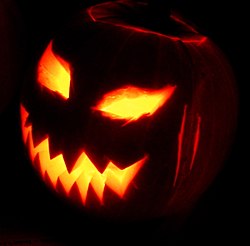
Samhain (or whatever it may be referred to) may have significant connections to the Celtic world (pre-Roman) spanning Ireland, Scotland, Galicia (northwestern Spain), Isle of Man, Wales, Cornwall and Brittany (northwestern France). Since the 16th century mumming and guising was common and both have evolved into 20th century trick or treating, visitations for treats and Halloween costuming. Bonfires were also traditional. Lanterns were carved out of hollowed-out turnips and these evolved into the jack-o-lanterns we know today with pumpkins. Many of the traditions were exported to the United States and Canada by the waves of Scottish and Irish immigrants in the 19th century. Through the American influence in the 20th and early 21st centuries, the American concept of Halloween spread to mainland Europe and to the Far East.

Of course, how can one not bring up Robert Burns' poem, Tam o' Shanter. From Wikipedia:
The poem describes the habits of Tam (a Scots nickname for Thomas), a farmer who often gets drunk with his friends in a public house in the Scottish town of Ayr, and his thoughtless ways, specifically towards his wife, who waits at home for him. At the conclusion of one such late-night revel, after a market day, Tam rides home on his horse Meg while a storm is brewing. On the way he sees the local haunted church lit up, with witches and warlocks dancing and the Devil playing the bagpipes. He is still drunk, still upon his horse, just on the edge of the light, watching, amazed to see the place bedecked with many gruesome things such as gibbet irons and knives that had been used to commit murders. The music intensifies as the witches are dancing and, upon seeing one particularly wanton witch in a short dress, Tam loses his reason and shouts, 'Weel done, cutty-sark!' ("cutty-sark": short shirt). Immediately, the lights go out, the music and dancing stop, and many of the creatures lunge after Tam, with the witches leading. Tam spurs Meg to turn and flee and drives the horse on towards the River Doon as the creatures dare not cross a running stream. The creatures give chase and the witches come so close to catching Tam and Meg that they pull Meg's tail off just as she reaches the Brig o' Doon.
The full text of the poem can be found at: https://www.gutenberg.org/files/1279/1279-h/1279-h.htm#link2H_4_0316 .
A full video of the poem can be found at: https://www.youtube.com/watch?v=fP_aFSuLeT0 .
Note that the poem is a mixture of Scots and English.
Sources